August 21, 2026 · 5 min read
Blocklists lied to you
You installed a focus app. You banned YouTube, Twitter, Reddit. For about three days it worked. Then you needed a lecture that happened to live on YouTube, and the wall you built to protect yourself became the thing in your way. So you added an exception. Then another. Within a week the blocklist was a colander, and you were back to surfacing forty minutes deep in a video essay about medieval siege weapons.
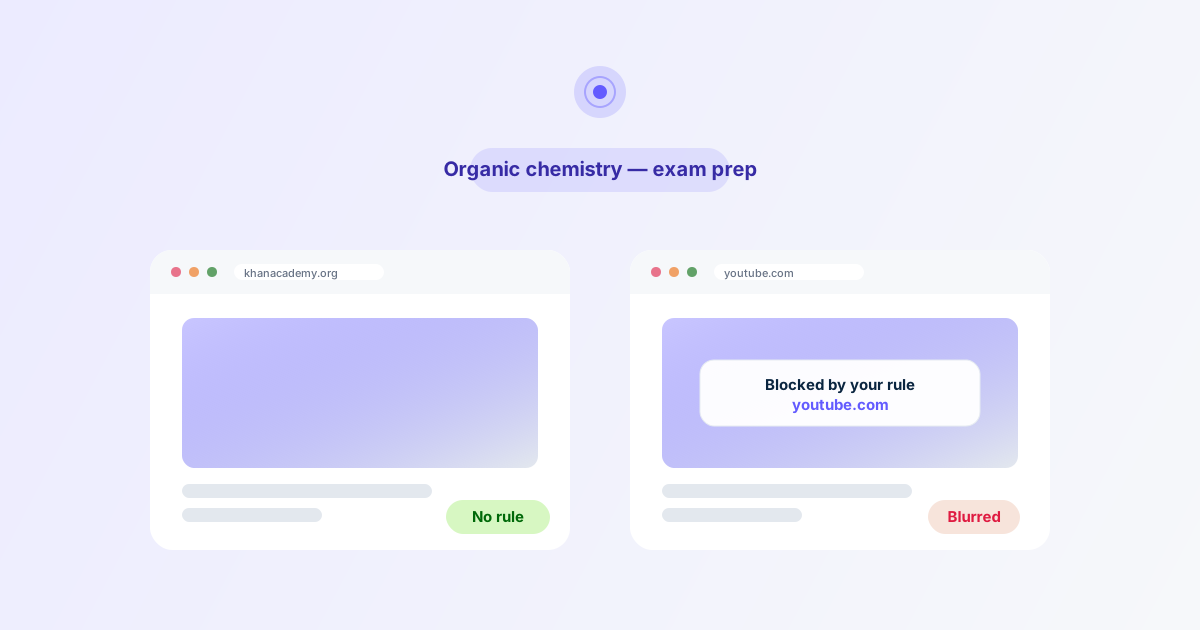
This isn't a willpower problem. It's a model problem — the mental model every mainstream focus tool is built on is wrong.
One list, all your work
Domain blockers — Freedom, Cold Turkey, BlockSite, StayFocusd — all share one shape: a single global blocklist you toggle on and off. One list, applied identically to everything you'll ever do. That shape fails in both directions at once:
- Too strict. YouTube carries the lecture your homework needs. GitHub is the actual job when you're coding. Ban the domain globally and you've banned your own work — so you add an exception, and the wall starts leaking.
- Too loose. Slack is essential at 9:00 and a distraction during a deep-work block. The one list can't say "not right now" — it only knows always or never.
Here's the part the blocklist tools never admit: the list isn't wrong, the scope is. "Sites I need" and "sites that distract me" aren't fixed sets — they trade places depending on what you're doing. No single list can be right for work that keeps changing. That's why you stopped maintaining it.
The better question
The question that matters is never should this site be banned? It's:
Is this site part of the work I'm doing right now?
Ask it that way and the fix is obvious: the rules should belong to the work, not to the browser. That's the whole idea behind Solidmind. Each kind of work gets a workspace — a name, a timer, a friction mode, and its own short list of what's off-limits for that work. Start a session on "Write newsletter" and GitHub blurs. End it, start "Client X code", and GitHub is back — while the news site blurs instead. Same browser, same sites, no list editing in between.
Ten rules that fit tonight's work beat a hundred rules that fit nothing. And the rules stay maintained where the global list rotted: when a new time-sink shows up mid-session, you right-click and block it for this session — two clicks, no settings screen. At the end, one sheet asks whether to keep it.
Why blur instead of block
Notice the second word: it blurs, it doesn't block.
A hard block page feels like punishment — a locked door with a stern message. A blurred page names the rule you wrote and offers a way out sized to how serious you told it to be: a timed unlock in Standard, typing END in Strict, nothing enforced at all in Open. You're not fighting a warden; you're being reminded of a promise you made an hour ago, by a tool that's on your side.
And enforcement is completely predictable: a page is blurred when your rule covers it, and never otherwise. No algorithm gets a vote, no "the AI decided". Only what you blocked is blocked.
"So it reads every page I open?"
No — by default it reads none. Deciding whether to blur is a comparison of the page's domain against your rules; there is no page analysis at all.
The one optional exception is the AI assistant: turn it on, and a small model running on your device may notice a page that looks off-topic and suggest blocking it — one tap accepts, ignoring it costs nothing. It can only suggest, never blur, and for it too:
Analyzed on your device by default; nothing is sent anywhere unless you explicitly enable a clearly-labeled cloud feature.
The point isn't focus. It's finishing.
Nobody wants "focus" as an end in itself. You want the exam grade, the shipped project, the report that was due. Focus is just the road there — and a one-size-fits-all blocklist keeps rerouting you off it.
Stop maintaining one list of enemies for every kind of work. Give each kind of work its own rules, and let the sites that don't belong to this session quietly fade while you finish the thing you actually sat down to do.